
Log In
Sign Up
PhD Student
PhD in multi-material 3D printing of monolithic self-sensing structures Full-time
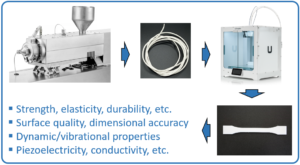
The Dynamics Lab of Dr. Rolanas Dauksevicius at the Institute of Mechatronics in Kaunas University of Technology (KTU) invites self-driven and skilled engineering candidates to apply for a competition-based admission to a doctoral study program in Mechanical Engineering under the PhD project ‘Multi-process additive manufacturing of self-sensing lightweight structures with monolithically embedded eco-friendly electronic composite materials’.
Why is the proposed project relevant?
Development of versatile physical field-activated additive manufacturing (AM) technology for multi-process 3D printing of monolithic (assembly-free) smart structures with structural and electronic composites is a key driver of several disruptive technologies: multi-material 3D/4D printing, integrated soft robotics and piezoelectronics, 3D-MID with structure-embedded sensors/nanogenerators for structural health monitoring (SHM). The field-activated AM process may be implemented by augmenting multi-process 3D printing (FFF/FGF/DIW) with auxiliary field-activated processing, e.g. applying photonic or electric fields to enhance properties of printed components via sintering, ablation, electrical poling of ferroelectric materials, etc. The process should be optimized to ensure repeatable manufacturability of self-sensing lightweight structures with directly embedded functional layers (electroactive, magnetoactive, thermoactive, etc.). To achieve scalability and environmental sustainability, electronic composites should be fabricated as filaments or granules using solvent-free melt extrusion of (bio)polymers filled with tailored fractions of ceramic, metal or nanocarbon particles. Durability of self-sensing lightweight structures is crucial in performance-critical applications such as autonomous systems or healthtech devices. Therefore, the field-activated AM process should provide design freedom to enable consistent and cost-effective on-demand printing of customizable and resilient smart structures with embedded electronic functions (e.g. sensing, energy harvesting, energy storage).
What are you going to do?
The PhD project will focus on: implementation of field-activated AM process for fully additive fabrication of monolithic self-sensing structures, including extrusion and characterization of multifunctional composite filaments/granules with superior mechanical properties and tailored electroactive properties (e.g. conductive, piezoelectric, dielectric, magnetic), optimization of multi-material 3D printing workflow integrated with auxiliary photonic and electrical processing and AI-assisted in-process quality control, DfAM and simulation-based design, prototyping and performance testing of 3D-printed electronic composites and self-sensing components intended for a performance-critical application. Candidate applications include 3D-printed geometrically complex and structurally efficient components with embedded SHM sensors (e.g. for integration into more compact, lightweight and energy-efficient ground, aerial or marine drone platforms), 3D-printed healthtech components with embedded sensing, heating and other functionalities (e.g. for integration into highly customizable wearable diagnostic devices).
The project is mostly grounded in mechanical, materials, manufacturing and mechatronics engineering. Depending on applicant’s skillset the research work may include electronics and control engineering activities.
How to get more information?
More information is available here (https://admissions.ktu.edu/phd/). PhD applicants should contact Dr. Rolanas Dauksevicius (https://orcid.org/0000-0002-4571-757X) by e-mail with their CV, copies of diplomas with transcripts and GPA, at least one reference, weblinks to published scientific papers or their pdf copies.