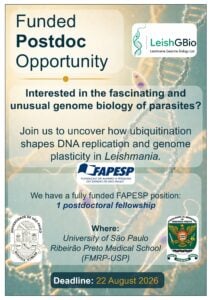
Job Description: The selected fellow will investigate how RING factors involved in ubiquitination pathways regulate genome maintenance and plasticity in Leishmania, within the context of a FAPESP Young Investigator Project. The work will involve the generation and characterisation of mutant lines using CRISPR/Cas9 and DiCre, analysis of cell-cycle progression by flow cytometry, assessment of DNA damage by microscopy, immunoblotting and ChIP-seq, as well as bulk and single-cell whole-genome sequencing to investigate mosaic aneuploidy.
Essential Skills: Full-time dedication to the project and compliance with the current FAPESP rules for Postdoctoral Fellowships. PhD completed within the last seven years in Molecular Biology, Biochemistry, Genetics, Cell Biology, Parasitology, Microbiology, Biotechnology or related areas. Proficiency in reading, writing and scientific communication in English. Proven experience in molecular and/or cell biology, including the cultivation of microorganisms or unicellular eukaryotes. Ability to analyse and interpret experimental data. Familiarity with bioinformatics tools and genomic analyses.
Desirable Skills: Although not mandatory, previous experience with Leishmania or other trypanosomatids, genome editing using CRISPR/Cas9 and/or DiCre systems will be considered an advantage. Experience with ChIP-seq, proteomics, sequencing data analysis and comparative genomics will also be viewed positively. Proficiency in programming languages such as R or Python will be valued. Co-authorship in scientific manuscripts, experience in student supervision and ability to work as part of a team will also be considered desirable.
Monthly salary: BRL 12,570.00, plus an annual research contingency allowance equivalent to 10% of the yearly salary. The fellowship is not taxable in Brazil.
How to apply: Applications must be sent to , with the subject line: “Postdoctoral Fellowship – Ubiquitination in Leishmania”. In the body of the e-mail, candidates should provide their full name and indicate two referees, including name, institutional affiliation and up to date e-mail address. The following documents must be attached as PDF files: a motivation letter, maximum two A4 pages; PhD completion certificate; PhD academic transcript; and CV, maximum four A4 pages.
Application Deadline: 22 August 2026
Tagged as: Life Sciences
Job Description: The selected fellow will investigate how the SCF/CRL1 ubiquitin ligase regulates the DNA replication programme in Leishmania, within...
ApplyPlease send your application to jezieldamasceno@fmrp.usp.br
Don't forget to mention that you found the position on jobRxiv!